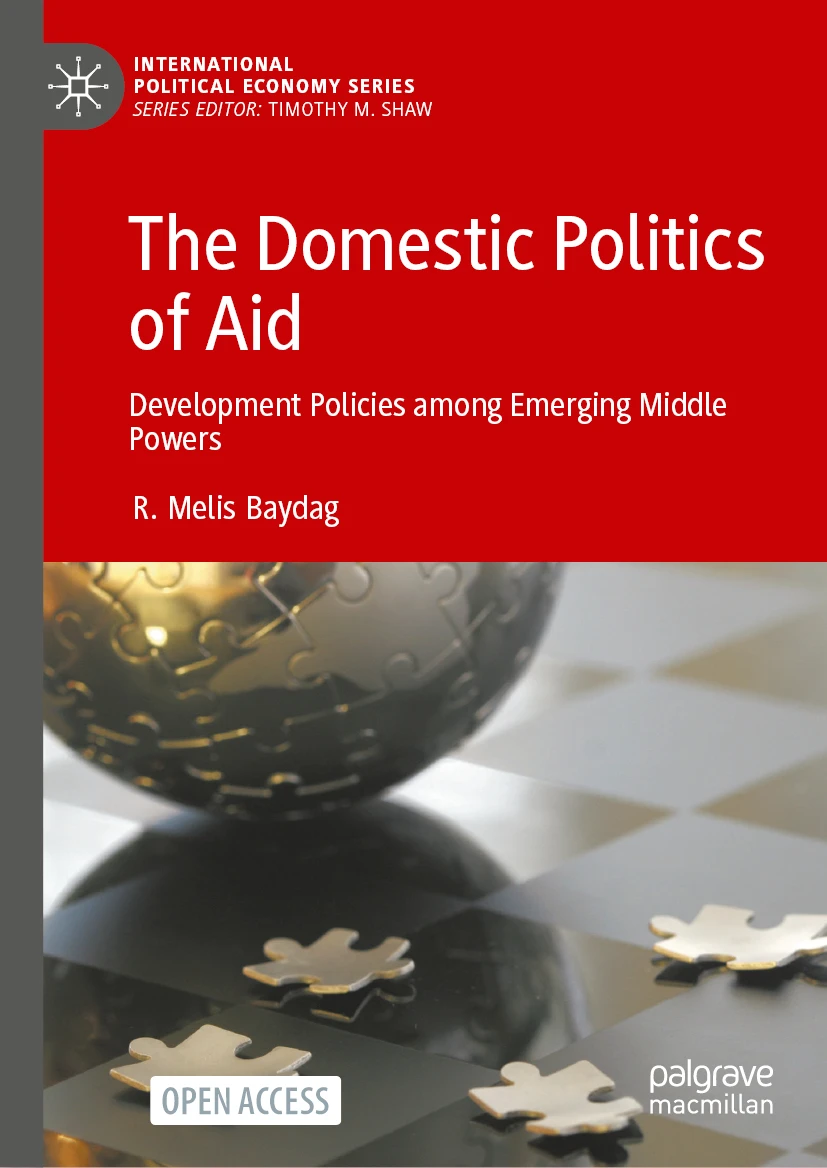
Monograph (forthcoming)
The Domestic Politics of Aid
Development Policies among Emerging Middle Powers
R. Melis Baydag
Palgrave Macmillan Cham | International Political Economy Series
[open access here]
Reviews
“Baydag uniquely helps us understand the mix of ideational and material motivations for foreign aid. By unpacking when and how these motivations animate decisions, we get a clear sense of not just the domestic politics driving aid decisions but also a more expansive picture of country motivations by extending the analysis to an important set of middle power countries. The book’s carefully chosen cases provide a fascinating analysis of interest to international political economy and international relations scholars.” -Dustin Tingley, Thomas Cabot Professor of Public Policy, Harvard University
“Melis Baydag’s book is a valuable and highly convincing comparative analysis of the domestic foundations of middle-sized emerging powers‘ development policies. It offers a theoretically guided and empirically profound examination of Mexican, Turkish, and South Korean policies by employing the Societal Approach to governmental preference formation. In an exemplary way, the author brings together rigorous hypothesis-testing and deep empirical insights into the role of value-based ideas and material interests in shaping preferences. Therefore, the book makes an important and novel contribution to IPE and to research on the domestic politics of middle-sized emerging powers‘ international policies.” -Stefan A. Schirm, Professor of International Politics, Ruhr University Bochum
“The development cooperation world is rapidly changing. Traditional development cooperation among OECD countries is, to a large extent, in crisis. The rise of South-South Cooperation, especially by China, is challenging established paradigms. A crucial dimension in this context is the role of emerging middle powers. South Korea graduated from developing-country status to become an OECD donor around fifteen years ago. Mexico joined the OECD as early as 1994, but has never become part of the DAC. The same applies to Turkey, although it was a founding member of the OECD. Understanding the domestic determinants of how these donors engage with development cooperation is crucial to identifying the reasons for their differing roles at the international level – especially since their aid policies are shaped, at least in part, by their participation in the OECD framework. This is why Melis Baydag’s monograph is an important contribution to current academic and policy-oriented debates.” -Stephan Klingebiel, Head of the Research Programme ‘Inter- and Transnational Cooperation’, German Institute of Development and Sustainability (IDOS)
“A groundbreaking study of the development policy strategies of three emerging middle powers: South Korea, Mexico and Turkey. Through a profound analysis of their domestic systems, it explains the variation in their international aid actions based on the definition of their national interests, priorities and preferences. A must-read for International Relations, International Development and Public Policy scholars, students and decision makers.”-Jorge A. Schiavon, Professor of International Relations, Universidad Iberoamericana
Journal articles
Fouquet, S., Baydag, R. M., Brummer, K., Schirm, S. A., Oktay, S., Moro, F., Moschella, M., Thies, C. & Wehner, L. (accepted, 18 January 2026). Forum: Dialogue instead of Mutual Neglect? International Political Economy Meets Foreign Policy Analysis. Cooperation and Conflict.
Hackenesch, C., Baydag, R. M., Keijzer, N. & J. Bergmann, J. (forthcoming). Rechtspopulistische Parteien in Europa und die Entwicklungspolitik: direkte und indirekte Einflussmechanismen. Zeitschrift für Politik.
Baydag, R. M. (2025). The political economy of aid giving: A literature review. Zeitschrift für Politikwissenschaft (first view). DOI: 10.1007/s41358-025-00448-3 [open access here]
Baydag, R. M. (2025). Domestic ideas and interests in development cooperation of emerging donors: The case of Mexican development policy. Contemporary Politics 31(5), 684-706. [open access here]
Baydag, R. M. & Villanueva Ulfgard, R. (2025). Populist narratives and personalized national role conception in middle powers: The cases of Mexico and Turkey during the COVID-19 Pandemic. Politics & Policy 53, 1-14. [open access here]
Baydag, R. M. & Klingebiel, S. (2023). Partner country selection between development narratives and self-interests: A new method for analysing complex donor approaches. Review of Development Economics 27(2), 1199-1223. [open access here]
Book chapters
Baydag, R. M. (2024). Positions of Established and Emerging Powers Towards Climate Finance: The Cases of Germany and Korea, in Klingebiel, S. et al. (eds.) Emerging trends in international development and green transitions: A focus on Korea and Germany. Palgrave Macmillan Cham , 39-52. [open access here]
Baydag, R. M. (2021). Middle powers in international development cooperation: Assessing the roles of South Korea and Turkey, in Chaturvedi, S. et al. (eds.) The Palgrave handbook of development cooperation for achieving the 2030 agenda: Contested collaboration. Cham: Palgrave Macmillan. [open access here]
Discussion papers, policy briefs and others
Keijzer, N. & Baydag, M. (2025). Turkey, the EU, and China in the world: Does turbulence lead to convergence? ETTG Blog. 17.11.2025 [available here]
Crumpton, B., Baydag, M., Keijzer, N., Rocca, C., & Erforth, B. (2025). Digital transformation in Africa: From gaps to goals. ETTG Policy Brief 7/2025. European Think Tanks Group. [available here]
Baydag, R. M. & Villanueva Ulfgard, R. (2025). Not all populists turn inward – and for a reason: Mexican and Turkish development cooperation in an era of global fragmentation. In S. Klingebiel & A. Sumner (eds.) Development and Development Policy in the Trump Era (IDOS Discussion Paper 23/2025). German Institute of Development and Sustainability (IDOS). [available here]
Baydag, R. M., Klingebiel, S. & Marschall, P. (2018). Shaping the patterns of development cooperation: A comparative analysis of seven bilateral donors and the European Union. (DIE Discussion Paper 22). German Development Institute. [available here]
„A micro-research on the materialities of programming languages: Using the example of an array in Java versus Python“ (with Anaïs Siebers), appears on the website of the Ruhr University Science and Technology lab (RUSTlab). [available here]
Work in progress
„Europe’s geoeconomic turn without aid? Domestic politics of British and German preferences.“
„Dividing at home, cooperating abroad: Turkey’s populist foreign aid policy.“ (for a special issue at TWQ).
„Interests, ideas, leaders: What drives development policies of emerging OECD donors?“
„Parsing populist leaders’ policy space: Domestic politics theories of IPE, personalistic-plebiscitary decision-making, and international economic conflicts“ (co-authored with S. Fouquet).
„Who belongs? Competing logics of like-mindedness within international organizations“ (co-authored with S. Klingebiel).